
Workshop on Model Predictive Control
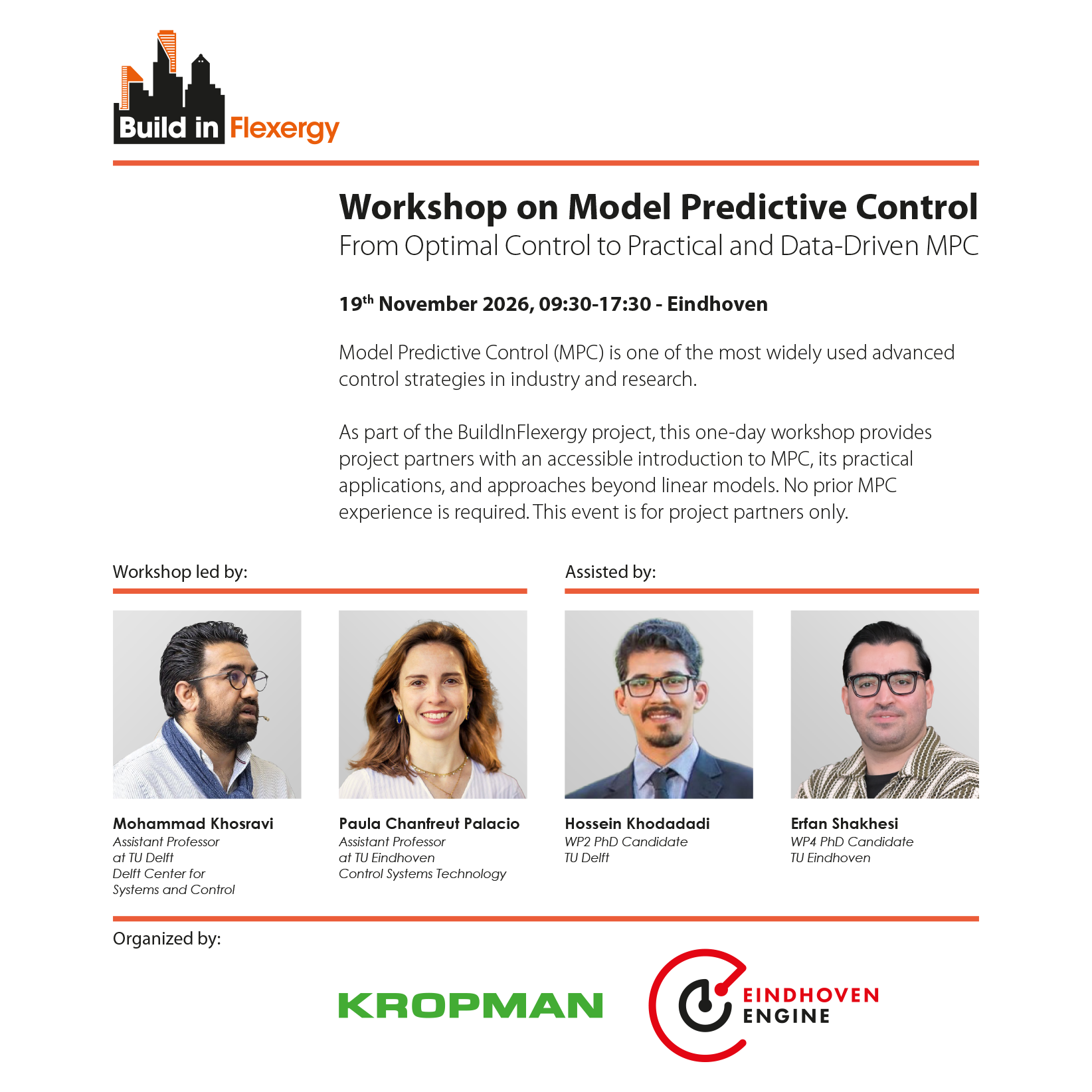
From Optimal Control to Practical and Data-Driven MPC
19th November 2026, 09:30–17:30, Eindhoven
Abstract
Model Predictive Control (MPC) is one of the most widely used advanced control strategies in industry and research. It computes control actions by repeatedly solving a finite-horizon optimal control problem, which lets it handle multivariable dynamics and explicit constraints on inputs and states. This one-day workshop introduces MPC from its foundations to current data-driven developments, combining lectures with guided hands-on breakout sessions.
The workshop starts with the fundamentals of optimal control: dynamic models, objectives, decision variables, and constraints. It then covers linear MPC, including the receding-horizon principle, prediction models, constrained optimization, and feedback implementation. A session on MPC in practice addresses the main challenges of deployment: tuning, constraint handling, disturbances, model mismatch, feasibility, and real-time computation. The final session moves beyond linear models and presents Koopman operator theory as a data-driven way to lift nonlinear dynamics into linear predictors that can be used directly within the MPC framework.
After each session, participants apply the concepts in breakout exercises. They formulate a control problem, build and tune a linear MPC controller, test its robustness to disturbances and actuator limits, and compare conventional and Koopman-based MPC in terms of tracking performance, constraint satisfaction, and computational cost. The workshop is aimed at graduate students, researchers, and engineers who want a practical, working understanding of MPC. Basic familiarity with dynamical systems and linear algebra is assumed. No prior experience with MPC is required.